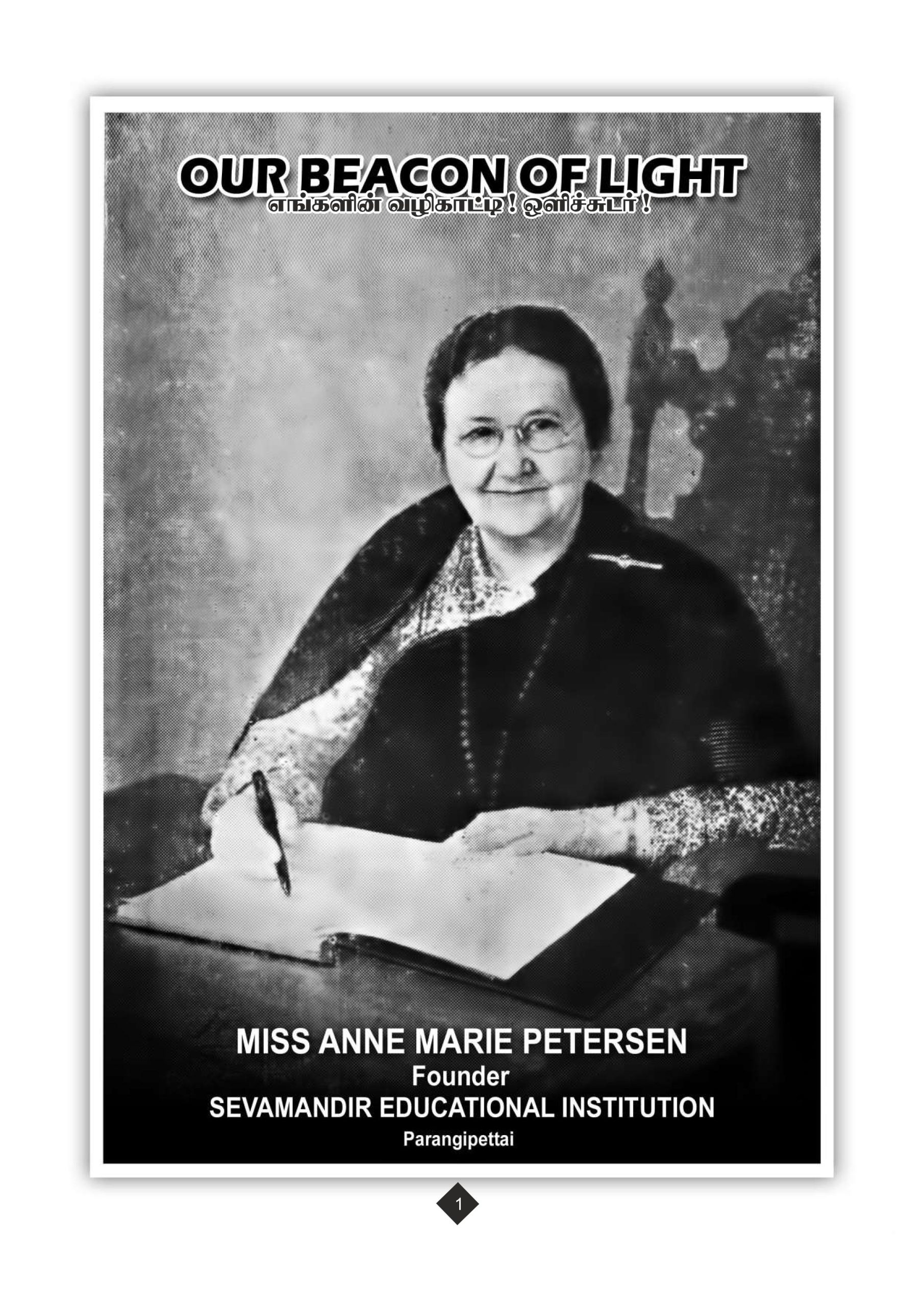
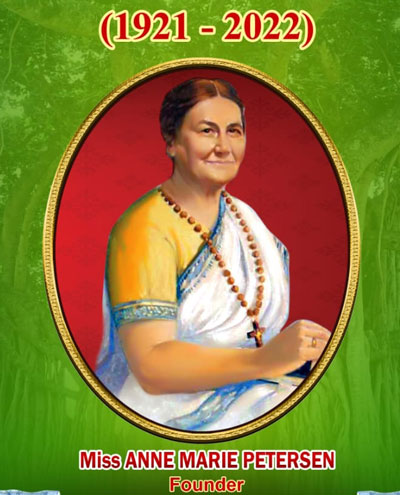
Anne Marie Petersen had a vision to start a school for girl children. On Sep 17, 1921, when Gandhi was his way to his tour in South India and travelling towards Cuddalore from Madras, she invited him to lay the foundation stone for Seva mandir (Temple of Service) and a National Christian Girls School at Porto Novo, Parangipettai. On Jan 20, 1924, with a motto “Love and Serve “, the Christian National Girl’s School was dedicated to the nation. Anne wanted the school to be national, Indian and Christian with equal importance to nationalism and spiritualism that reflects Indian spirituality. The buildings were built on Ashram style reflecting the Indian way of learning and worship. In 1927 only six girls were present and until 1935 the school progressed slowly. For the children in Parangipettai, this school became a great empowering centre for rural girls’ children that were opened for all girl children from nearby villages. It became home for many destitute and untouchable children who were brought up in the national spirit with a commitment to their land and people and to empower the rural people of India.
The only Educational Institution, throughout the nook and corner of the Southern India, whose foundation stone was laid and blessed by Gandhiji, the Father of Nation, was Sevamandir and true to its name which signifies, ‘a Temple of Service’ it served the Nation in its own way in the worst period of its National struggle against foreign rule, by participating in the National Movement launched by its Leader Gandhiji, one after the other – say whether it was ‘Civil Disobedience Movement which was otherwise known as ‘Non-Cooperation Movement’ launched by Mahatma Gandhiji in 1921. ‘Salt Sathyagraha’ in 1930s. ‘Boycot of Lancashire Mill Textiles, in 1933. Boycot of Liquor shops campaign in 1937. ‘Temple Entry and Removal of Untouchability campaign, in 1940s and the last and most distinguished was the ‘Introduction of Wardha System of Basic Education’.
Sevamandir sent its students to distinguish themselves in the Fine Arts (singling and Drama) to the far-off Shanthineketan to the nearest Annamalai University to take Diploma in Tamil and Indian carnatic Music, as it wanted to nurse and encourage ‘oriental culture’ of the country. The very entrance door and the magnificent pillars that adorn the vast Corridors of ‘Sevamandir’ speak of the ancient Indian skill in ‘Wood Architecture’ and its cultural heritage. Periamma was a lover of Indian Arts, music, Dress, and Meals – Though she was a Dane she was an Indian to 100 percent to the core.
Anne Marie Petersen is one of the most remarkable mission workers, who ever worked in India.
She died in 1951 and the newspaper Harijan wrote:
“There was a peculiar spiritual understanding between herself and Gandhi, who used to call her, “My Anni Marie”…To the last she remained a devoted admirer and follower of Gandhi and she belongs to the blessed group of foreign friends, who served India in complete harmony.”