- +91 4144 243505
- shalom_seva@yahoo.com
- AGARAM, PARANGIPETTAI - 608502 CHIDAMBARAM TK, CUDDALORE DT,
THE LIFE AND WORK OF THE DANISH MISSIONARY
At the beginning of the nineteenth century, an increasing interest for mission arose in the western world. It spread from Germany through Great Britain reaching Denmark, and as a result The Danish Mission Society (DMS) was founded in 1821. The work carried out by the DMS in the Arcot area in South India, goes back to 1863, when the German missionary C.C. Ochs was employed in the DMS, working in Pattambakkam. The first Danish missionary in India, who founded a mission station in Tirukoilur in 1869 was Peter Andersen. From 1900 the DMS had an extensive missionary work in the Arcot field, including hospitals, schools and mission stations.
The Danish Mission Society represented one mainstream in the Danish Evangelical tradition and was founded in a strict Lutheran piety. The other one being the Grundtvigian, a cultural more liberal trend, established by the Danish priest, philosopher and hymn writer: N.F. S. Grundtvig (1783-1872). The Grundtvigian movement supported the two missionaries Eduard Loeventhal and Anne Marie Petersen (AMP).
The Loeventhal Mission was the first attempt to conduct a mission work based on the ideas and visions regarding man, people and Christianity formed by Grundtvig. Grundtvig believed that someday a great Christian community would rise in India, on the banks of the river Ganges. These prophesy became essential to further mission work in India and for the followers of his ideas. Eduard Loeventhal was working in South India from 1872 – until 1914. (The Loeventhal Mission). In 1909, the Danish schoolteacher, Anne Marie Petersen arrived to India, in order to follow her vocation as a missionary and to become Loeventhals assistant.
In 1916 Anne Marie Petersen visited Mahatma Gandhi’s ashram Sabarmati near Ahmadabad. This experience should prove a turning point to her mission work. From this moment her aim was to establish a Christian national school for girls based upon the model used by the Danish Folk High School and the living- and working conditions in Gandhi’s ashram-basic education.
The First World War meant a new agenda for Christian mission in India, especially at the time when Gandhi entered the Indian scene. As a result missionary work became conditioned by political loyalty toward the British colonial power. The missionaries were forced to take a stand concerning their personal viewpoints with respect to the national question and regarding the independence movement, which had emerged.
At the DMS´ Missionary Conference held in 1920, a debate and referendum was going to take place among the participants in order to clarify whether or not, Indian missionaries could obtain equal rights and enjoy the same privileges as the Danish missionaries. Anne Marie Petersen and two other Danish missionaries were in favor of this, nevertheless the proposal failed and shortly after, AMP stopped her cooperation with the DMS. After her resignation from DMS, she became a wholehearted supporter to the national movement lead by Gandhi.
There were two sides of Anne Marie Petersen’s work as a missionary. First and foremost, the public issue, which manifested itself in her involvement towards Gandhi and the National Movement. Then the religious and missionary aspect, which was closely connected to the Indians, who wanted to establish an Indian theology, among those was Sadhu Sundar Singh and V. Chakkarai. AMP supported their interpretation of Christianity, where the main emphasis was to be laid on Bhakti, being devotion and love, rather than truth and wisdom.j
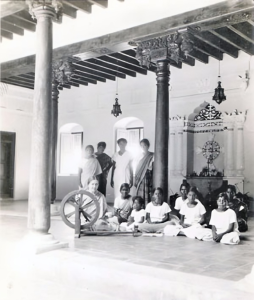
Sevamandir could boast itself that it was the First Institution in the South which defied the Foreign rule, by refusing to get recognition by the Govt. thereby foregoing any Govt, grant, It introduced ‘Spinning and Weaving as Handcrafts, as a part of curriculum as far back as in 1922 ie even before the introduction of Gandhiji ‘craft based’ Wardha system of Education in late Forties, and it afforded ‘home’ to a section of less fortunate community young widows who were socially outcastes victims of a social tyranny practice before the legislation of Sharadha Act and affording shelter to many an orphan without any distinction and caste or Religion, and providing a free education unfettered by the rules and regulations by Govt.
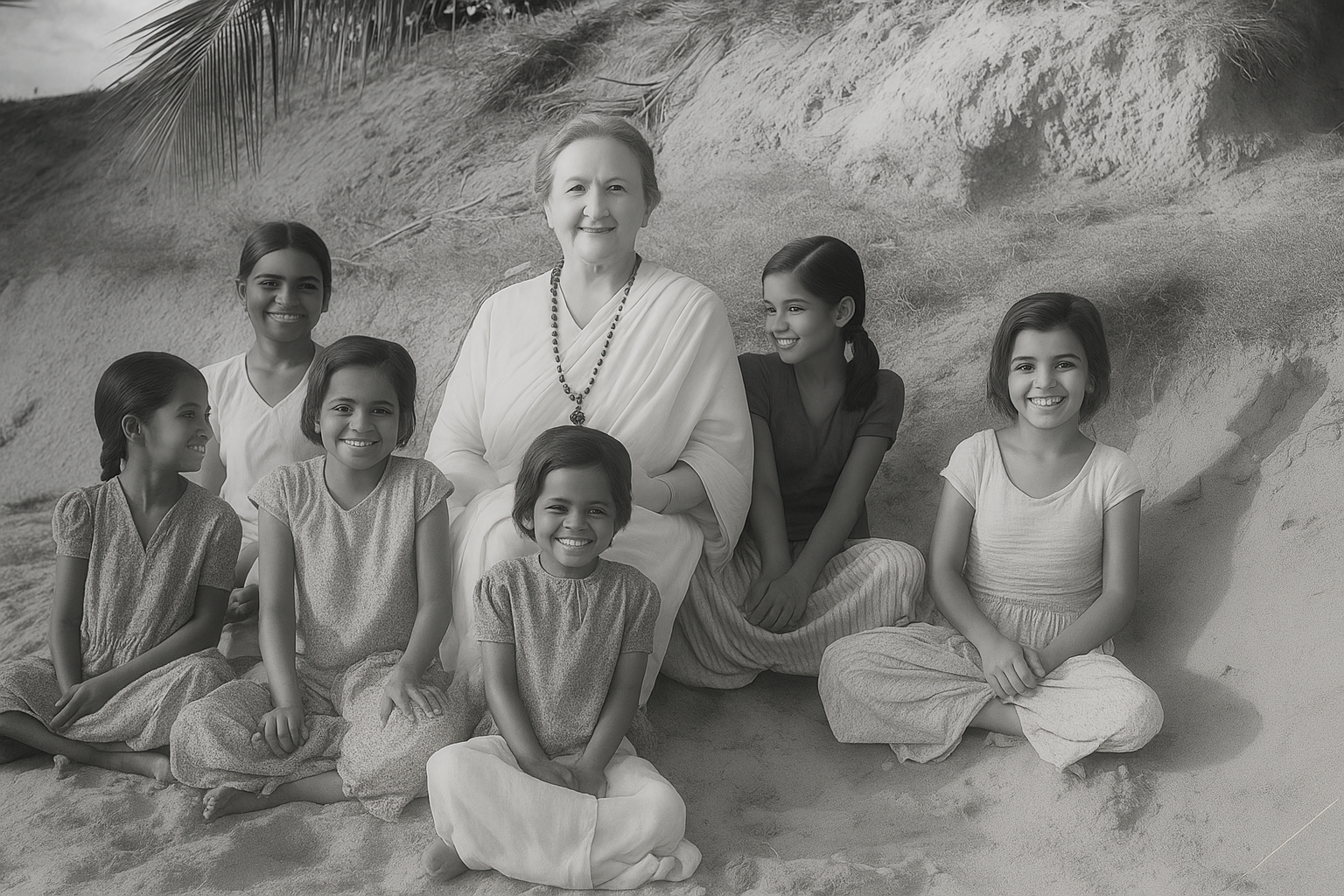
Ms. Annie Marie Peterson had in her mind ‘National Christian Girls School’ in 1921 on its inauguration. On seeing the service of this institution, Gandhiji changed its name as “SEVAMANDIR’ which signifies ‘TEMPLE OF SERVICE’
In 1949, Sevamandir was recognized as JUNIOR BASIC TRAINING SCHOOL’. In 1956, the junior basic training school was converted into a SENIOR BASIC TRAINING SCHOOL.
At present, Sevamandir comprises of a Primary school, a Higher Secondary School for girls, a hostel for school girls. It is a fully residential school and around 1500 inmates (students and teachers) at Sevmandir family. Many parents and students prefer Sevamandir for the education. And at the same time, the people of in and around Parangipettai asked for a matriculation school and thereby, Sevamandir started a Matriculation school to fulfill the desires of the people to get the local support.
Unfortunately, as per the Government norms, we were forced to close the TTI due to the lack of sufficient strength in 2023.
All the students live in the campus itself making the life of Sevamandir bright and active and very constructive for this generation.
Sevamandir will always stand for the noble principles of our FOUNDER.